


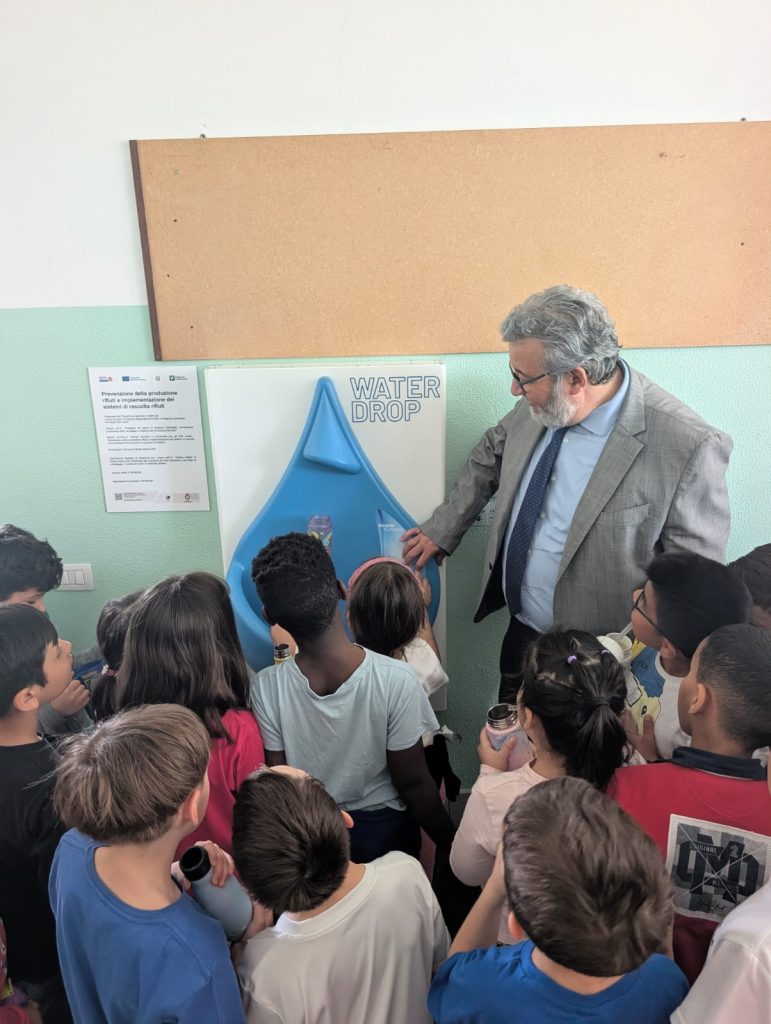
In recent weeks DKR has taken part in the inaugurations of the new drinking water dispensers installed in the schools of Busto Arsizio and Casei Gerola, two Lombardy municipalities that have chosen to invest in mains water and the reduction of single-use plastic thanks to the regional RI.Circo.Lo tender. In Busto Arsizio we have installed ten Water Drop Box dispensers across six school complexes, from nursery to middle school; in Casei Gerola we have installed four Water Drop Boxes in the schools and gymnasium, and two pillar-mounted DKR dispensers from the Voreal line in the town hall and library. These systems are not just modern drinking fountains, but become educational tools around which teachers build learning pathways on the water cycle, purification and the conscious use of a precious resource. In this article we recount what we have seen on the ground, why school is a strategic place for change, and what features make the Water Drop Box, in the children's own words, “the superhero that fights plastic bottles”.
For over thirty years, DKR has been designing and installing water dispensing solutions, supporting local authorities, schools and public spaces at every stage of their journey. For this reason, we are particularly proud to have been invited to the inauguration ceremonies in Busto Arsizio and Casei Gerola: what we saw confirmed that, when technology and education work together, the impact goes far beyond the simple installation of a system.
In Busto Arsizio, despite the proximity to our Rescaldina headquarters, it was the first time we brought our Water Drop Box to the city's schools. Together with the local council and the Galilei comprehensive school in Sacconago and Borsano, we installed ten dispensers in six school buildings (from early childhood to lower secondary school) positioning them in the corridors and high-traffic areas to facilitate access throughout the day. The systems dispense Tap water unfiltered, controlled, and safe, at strategic points within buildings.
In Casei Gerola, the path with the Municipality has deeper roots: the first Water House we installed it in 2012. Subsequently, Casei Gerola installed a second water kiosk, an XP 2.0 model installed in 2022, which also serves the neighbouring municipality of Cornale and Bastida, which share the maintenance costs. Today the administration has chosen to go ahead with four new Water Drop Boxes, distributed in the schools and the gym, and two floor-standing DKR dispensers from the Voreal line in the town hall and library. In this way, public and free water enters the places of daily life of the entire community, and is not confined to a single access point.
During the inaugurations, we met children and young people of all ages, from nursery schoolers to middle school students. What struck us most was their level of awareness: they weren't there out of curiosity, but because they had already studied. Indeed, the primary and secondary school teachers had built educational pathways on water in the preceding weeks, transforming the arrival of the water dispenser into an anticipated event, the culmination of work already started in the classroom.
Both Busto Arsizio and Casei Gerola were able to carry out these interventions thanks to the Circus band, promoted by the Lombardy Region to support waste reduction and circular economy projects. This is a practical tool that allows local authorities to support the initial investment for “plastic-free” infrastructure (dispensers, reusable tableware, equipment for canteens) without placing the full burden on municipal budgets.
In Busto Arsizio the grant covered, in addition to the Water Drop dispensers, the purchase of glass jugs, cups and reusable tableware for the school canteens: an integrated package that reduces single-use plastic on multiple fronts simultaneously. In Casei Gerola, the call for tenders supported the decision to bring Water Drop Box even in places open to the public, not just in classrooms.
From our point of view, this type of funding is important because it pushes local authorities to make a qualitative leap: it is not about replacing the small plastic bottle with a reusable one by decree, but about redesigning access to water as
local public service, combining it with information, school engagement and communication with citizens. When a technical choice is accompanied by an educational project, the facility becomes part of a permanent change, not a passing fad.
As mentioned previously, one of the aspects that struck us most in Busto Arsizio and Casei Gerola was the work carried out in class in the preceding weeks. The students prepared posters, drawings and research projects on the water cycle, water purification in the aqueduct, and the correct use and conservation of the resource.
Nursery school children represented water through images and short stories, transforming the new water dispenser into an almost fairytale-like character. Primary and secondary school pupils, on the other hand, worked on diagrams and presentations that clearly explain where the water we drink comes from, what checks it undergoes along the water supply network and why it is important to prefer tap’Tap water all packaged alternatives.
This preparation makes a huge difference: when we enter a school where water has already been talked about and studied, the installation of the Water Drop or the Water Drop Box is perceived as the natural completion of a journey, not as an object dropped from above. It is the moment when theory connects with everyday gestures, such as turning on the tap, filling a water bottle, and drinking together with classmates, and makes them meaningful.
For us, this is the best way to transform a facility into an authentic educational tool: not a visual aid to hang in the classroom, but a physical point around which to build. Environmental education projects and active citizenship.
When we install a dispenser in a school, the central theme is not just “where to drink”, but “how one chooses to drink”. The presence of a modern and accessible water fountain encourages students to bring Water bottles and reusable cups, measurably reducing the input of PET bottles in classrooms and canteens.
From an environmental point of view, every reusable water bottle filled means one fewer single-use bottle to produce, transport and dispose of. Around 8 billion 1.5-litre bottles are consumed in Italy every year: a huge number that generates over 280,000 tonnes of plastic waste and millions of tonnes of CO₂ linked to the supply chain. Across an entire school, over a school year, the reduction in plastic can amount to thousands of containers.
There is also an economic dimension, which is often underestimated: for families, getting used to tap water means reducing the recurring expense of bottled water; for local authorities, better organisation of water dispensing points helps to contain waste management costs. But above all, there is a long-term cultural effect: when tap water becomes the norm at school, the same behaviour is more likely to be replicated at home, at the gym, and out and about.
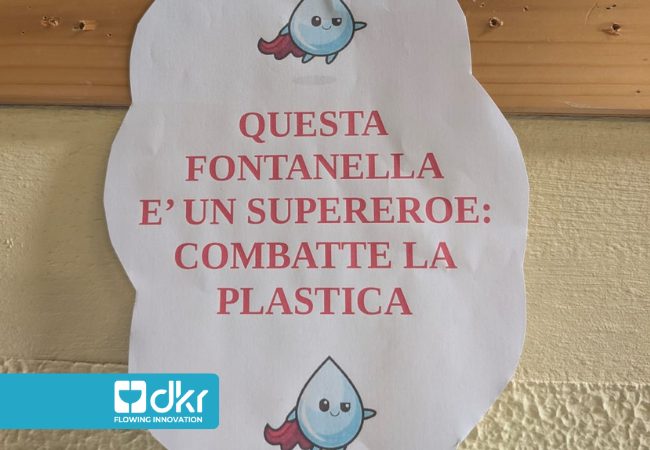
Among the drawings displayed near the water dispensers during the opening ceremonies, there was one that particularly caught our eye: “Water Drop Box”, depicted as a superhero in a cape, with the caption ‘fights plastic bottles’. In just a few words and with a pencil, a child had perfectly captured the essence of the project.
When young children give a technical object a name and a face, it means they have incorporated it into their own experience. From that moment on, going for a drink is no longer a neutral act, but becomes part of a story, a narrative shared with the class. This is how sustainability ceases to be an abstract concept and becomes a daily habit, repeated every morning.
For us, designing school facilities It also means imagining how they will be experienced by children, how they will enter into their stories and whether they can truly become “allies” in the journey of growth towards a more conscious citizenship. The inaugurations in Busto Arsizio and Casei Gerola have confirmed to us that when a project is done well, this really happens.
Discover how to install Water Drop Box in school complexes and public spaces in your local area. We support administrations at every stage: from assessing requirements to managing the RI.Circo.Lo call for tenders, right up to the inauguration.
Contact us for free advice and turns the public water supply into an educational tool for the whole community.
Because it gives pupils easy access to tap water throughout the day, reducing the use of single-use plastic bottles and promoting healthier drinking habits. The facilities also serve as practical teaching tools, around which projects on water, the environment and responsible consumption can be developed.
Yes. The systems use mains water, which is subject to continuous monitoring in compliance with current legislation. Depending on the requirements of the water utility and the administration, we can integrate filtration and sanitisation systems to further optimise quality and hygiene.
Yes, it was designed precisely for this. The surfaces are rounded, there are no sharp edges or exposed components, and the spout allows you to drink comfortably even without a container. It's one of the elements that sets it apart from competing solutions on the market.
No. Water Drop Box allows you to drink directly from it, like a traditional fountain, and to fill any container. The choice is free and depends on each student's habits, without excluding anyone.
The first step is to assess the needs of schools and public spaces, then identify available funding sources, such as the RI.Circo.Lo call for tenders or other regional measures. We at DKR support local authorities throughout the entire process: from choosing the most suitable system to communicating the project to teachers, families and citizens.

Via Grigna, 60 - 20027 Rescaldina (MI) - ITALY
Tel. +39 0331 54 94 67 - Fax +39 0331 54 49 01
info@dkr.it - dkr@pec.it



 English
  Italian
  Spanish
  French