


Limescale is a constant threat to plumbing systems and appliances in homes and businesses, prompting many to look for water treatment solutions. This article sheds light on the technical workings of these devices, analysing the differences between ion exchange models and alternative technologies. With technical support from our partner Enki Water, we will dispel some false myths about human consumption of softened water, clarifying regulations and the real health implications. Finally, we will illustrate how DKR's logic integrates technical treatment with specific solutions for drinking water.
To fully understand the need for action on the domestic or industrial water supply network, it is first necessary to analyse the common enemy: limestone. Chemically known as calcium carbonate, this element is the product of the precipitation of naturally occurring calcium and magnesium ions in water. Although these minerals are not harmful in themselves to human health, the “hardness” of water causes particularly tenacious scaling when the liquid undergoes changes in temperature or pressure. To counteract this phenomenon, which damages pipes and boilers with often considerable repair costs, the most widespread and reliable technical solution is the installation of a water softener.
It is essential to clarify immediately a concept that often causes confusion in the end consumer: this device is not a water purifier, nor is it a filter purifier. Its primary purpose is technological. The operation of classic models is based on a chemical-physical process known as “ion exchange”. Inside the device is a cylinder containing special synthetic food resins, charged with sodium ions. When hard water passes through these resins, a targeted exchange takes place at the molecular level: the resins act as a chemical magnet that attracts and retains calcium and magnesium ions (the culprits of fouling) and releases sodium ions into the water in return. Once the resins are saturated and can no longer absorb calcium, the softener automatically initiates a “regeneration” phase by washing the resins with a solution of water and salt.
If we analyse the issue from the point of view of system maintenance, the benefits of using a water softener are undeniable. As confirmed by industry studies (Altroconsumo, 2008), the savings for an average family of four can be between EUR 500 and EUR 800 per year.
The market offers different configurations. To choose the right water softener, a distinction must be made between the types of construction.
I cabin models are the solution for the domestic environment: a single, compact block containing both the resin bottle and the salt tank, ideal for confined spaces. They are the most common choice for private homes due to their ease of installation and compact design.
The single-column softeners physically separate the resin cylinder from the brine vat; this configuration is typical of medium-sized plants where more flexibility in installation is needed.
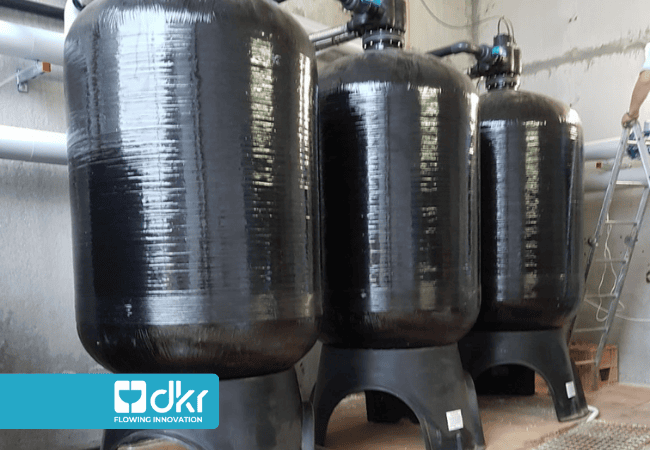
Then there are the duplex (or dual body) systems, which use two alternating resin columns to ensure 24-hour softened water without interruption during regeneration. This solution is preferred in settings such as Alyeska, industrial softeners, hotels, restaurants, hospitals and activities where an uninterrupted supply is essential.
In this regard, it is interesting to mention the technological excellence of our partner Enki Water, which offers systems such as Hydrus, hydrodynamic (electricity-free) industrial softeners capable of handling huge flow rates with unparalleled efficiency.
There is often confusion between softening and physical (magnetic or electromagnetic) treatments. The latter convert limestone into aragonite (a powder that does not crust) but, as Enki Water's technicians point out, «do not change the hardness and do not generate one euro of the above-mentioned savings».» (neither on detergents nor on energy). In addition, the manufacturers of modern heat pumps often impose that the hardness must not exceed 17°f, on pain of forfeiting the warranty: a result that magnets cannot guarantee, risking the revocation of the Conto Termico 3.0 incentives as well. At present, ion exchange remains the only technology that guarantees the result and savings.
It is time to shed light on a debated topic: can softened water be drunk? The answer, supported by technical and regulatory data, is yes. The softener does not compromise the potability of the water.
Excess sodium is often feared. However, the legal limit is 200 mg/l. Even in pushed systems, 180 mg/l is rarely exceeded. Modern Enki Water systems, for example, exchange around 45 mg/l of sodium, a negligible amount that does not affect the health of people with heart disease or hypertension in everyday life.
The fear that the softener “takes away minerals” is also unfounded. The device only acts on calcium and magnesium (often present in excess) and, thanks to the bypass setting, still leaves an adequate amount. It should be remembered that the minerals needed by the body come mainly from food, not water. Suffice it to say that some of the finest bottled waters on the market (such as Plose or Sant'Anna) have very low hardnesses (0.5 °f), far lower than those of treated tap water.
Another myth to dispel concerns pipe corrosion. It is not simply the absence of limescale that causes pipes to crack. As Enrico Zanchi of Enki Water explains: «Corrosive power is only influenced for 25% by hardness. Langelier's index, which also considers pH, temperature and alkalinity, is the real parameter to be analysed.».
The old regulation imposing a minimum limit of 15°f is in fact technologically outdated. In new buildings, a water softener is calibrated even at 5°f to provide maximum comfort and savings without risk. In older dwellings, a higher calibration (around 10°f) is only maintained to prevent the water from too aggressively cleaning old encrustations that “seal” any dated micro-fractures.
Moreover, thanks to new materials and the strict EU 2020/2184 regulations, the risk of bacterial growth in resins is a problem of the past.
Although softened water is safe, in an ideal world - as our technical partners also suggest - each building should have two separate lines: a technical (softened) and a food line. This would allow the best technology to be used for each purpose without interference.
Using a water softener to serve technological systems (boiler, washing machine, shower) is the best choice to protect your real estate investment and save money. For food use, on the other hand, one can opt for a hydraulic by-pass (tap with unsoftened mains water) or, for those seeking excellence, rely on refining solutions.
And this is where DKR's specialisation comes in. While we handle the technical side with excellent partners like Enki, we focus directly on specific solutions for human consumption that enhance taste and safety.
For municipalities, we install water houses, modern territorial garrisons that offer citizens controlled and sustainable chilled, still or sparkling water.
Instead, we offer our advanced dispensers for offices, schools and the catering industry. These systems use microfiltration or ultrafiltration technologies to remove chlorine (often unpleasant to taste) and impurities, refining the organoleptic characteristics of the water without having to chemically modify its saline composition.
Treating water is a serious responsibility. The borderline between a technological benefit and an optimal result depends on competence. Relying on DKR and its technical partners (such as Enki Water for softening) means having the certainty of a tailor-made solution. It means installing a high-performance water softener where you need it, and drinking excellent water where you want it, improving your quality of life and respecting the environment.

Via Grigna, 60 - 20027 Rescaldina (MI) - ITALY
Tel. +39 0331 54 94 67 - Fax +39 0331 54 49 01
info@dkr.it - dkr@pec.it



 English
  Italian
  Spanish
  French