


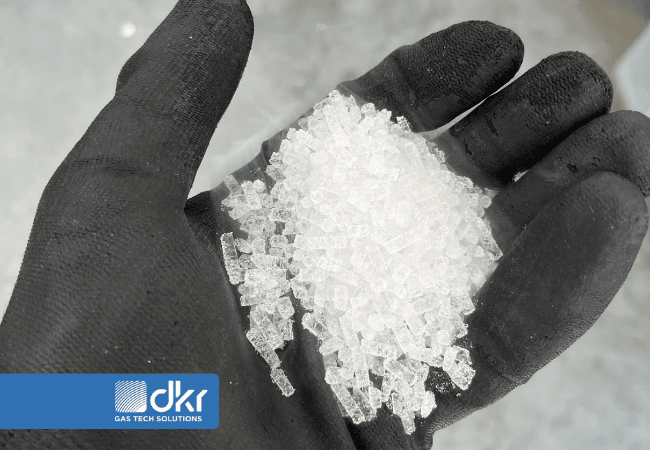
Dry ice is a versatile and safe tool, as long as one knows the risks and follows the correct handling procedures. This comprehensive guide explains the three main hazards (cold burns, CO₂ build-up and overpressure), how to handle it correctly with the necessary personal protective equipment, rules for safe storage and transport, and first aid procedures in case of accidental contact. With the right awareness and appropriate precautions, dry ice can be used safely in professional and private settings.
The safety of dry ice is paramount: this material fascinates and amazes. Its iconic white mist and ability to cool instantly make it a powerful tool in many sectors, from logistics to catering.
However, its extreme temperature (-78.5°C) requires awareness and correct usage procedures. The answer to the question “Is dry ice dangerous?” is simple: no, if handled with knowledge and respect.
At DKR - Partner SIAD, safety is an integral part of the service: in addition to providing high quality dry ice, we share all the necessary information for safe and responsible use.
Knowing the risks is the first step to avoiding them. The dangers of dry ice are three, all of them easily manageable with the right precautions.
Dry ice is extremely cold and prolonged contact with the skin can cause a cold burn similar to that caused by a hot object.
A contact short and not prolonged, instead, does not entail significant risks, although the use of insulating gloves is always recommended.
To prevent any risk, avoid prolonged direct contact and use cryogenic gloves when handling.
Dry ice does not melt but sublime, directly into carbon dioxide (CO₂) gas.
Since CO₂ is heavier than air, in environments closed and unventilated can replace oxygen, causing headaches or breathing difficulties.
The risk is insignificant in open or normally ventilated rooms, as warehouses or workshops.
It is therefore important to ensure good ventilation, especially in small rooms or during transport.
During sublimation, 1 kg of dry ice generates about 500 litres of CO₂ gas..
If stored in an airtight container (e.g. unventilated bottles, jars or freezers), the pressure may increase to the point of bursting the container.
Just in case, never seal completely dry ice: always use suitable, ventilated containers.

Store dry ice in insulating but not airtight containers, such as those in expanded polystyrene (EPS) o polyurethane.
These slow down sublimation but allow the gas to escape safely.
Never store it in a non-ventilated domestic freezer, as the temperature can damage the thermostat and the accumulated CO₂ can create pressure.
The ideal storage temperature is between -60°C and -80°C.
During transport, place the container in the load compartment or boot, avoiding direct contact with the passenger compartment.
Always guarantee a adequate ventilation, leaving one window ajar to allow for air exchange.
Dry ice is a extremely useful and safe tool if used consciously.
DKR - SIAD Partner supports its customers with quality products and clear instructions for responsible use, in full compliance with regulations and operational safety.

Via Grigna, 60 - 20027 Rescaldina (MI) - ITALY
Tel. +39 0331 54 94 67 - Fax +39 0331 54 49 01
info@dkr.it - dkr@pec.it



 English
  Italian
  Spanish
  French