


Reverse osmosis is often cited as the ultimate technology for water purification, capable of making almost any liquid drinkable. But is it always the right choice for the home, office, or restaurant? In this technical article, we explain the functioning of the semipermeable membrane, analyze the pros (removal of heavy metals and pollutants) and cons (demineralization, wastewater disposal, and acidity). DKR guides you through the understanding of this powerful technology, explaining when it is indispensable and when microfiltration may, in some cases, be a more logical and sustainable choice. In the vast landscape of water treatment, few technologies are as well-known and discussed as reverse osmosis. Often sold as the panacea for every water problem, it is sometimes marketed as the only way to have “pure water.” Unfortunately, the sector is affected by some retailers who adopt a non-neutral approach, seeking to sell the most expensive product instead of the most useful one; this harms the entire market and confuses the end customer, despite the efforts of trade associations such as AIAQ, Acqua Italia and Amitap to promote proper commercial ethics.
However, as we have often reiterated in our technical column, in DKR (which produces delivery systems and not filtration systems) we do not believe in universal solutions. For this reason, we strive to be neutral in the description and use of these technologies, relying on the opinion of external experts, such as Mr. Danilo Turola of the company Filtra, a company specializing in water treatment founded in 1999 with roots dating back to the 1970s, now in its third generation and part of a group capable of covering the water treatment market at 360°.
To respond, we must abandon the slogans and delve into fluid mechanics and chemistry.
To understand reverse osmosis, we first need to understand natural osmosis. In nature, when two liquids with different salt concentrations are separated by a semipermeable membrane (which allows water to pass but not salts), water tends to move from the less concentrated solution to the more concentrated one to dilute it and balance the salinity.
Reverse osmosis reverses this natural process by applying an external force.
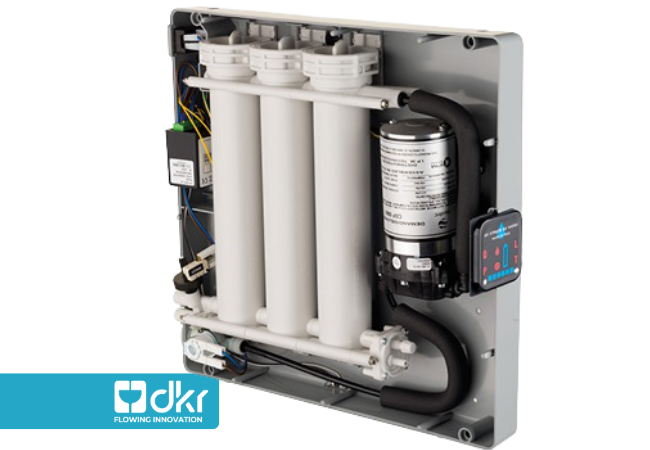
Through a high-pressure pump, water with a high concentration of mineral salts is forced against a synthetic membrane with extremely small pores (in the order of 0.0001 microns). The pressure overcomes the natural osmotic resistance and forces the molecules of pure H2O to pass through the other side, leaving almost all dissolved substances (salts, metals, bacteria, viruses) behind.
The result is the separation of the flow into two paths:
Reverse osmosis is, technically, the most advanced filtration method available at home and in industry. Its advantages are objective in critical situations:
Technically advanced solutions are available on the market today, such as the patented HDO and FLO reverse osmosis systems by Filtra, which are distinguished by their quick and simple maintenance, an aspect often underestimated when choosing a domestic system.
If osmosis is so powerful, why doesn’t DKR recommend it to everyone indiscriminately? Why does this technology have chemical and environmental “costs” that need to be carefully evaluated.
Osmosis does not distinguish between “bad” and “good” water. It removes arsenic, but also removes calcium, magnesium, and potassium. The result is an oligomineral water, poor in nutrients and with a generally acidic pH. The World Health Organization (WHO) has repeatedly reported that drinking exclusively demineralized water for long periods can have contraindications, as it reduces the intake of micronutrients and can have an excessive diuretic effect. Furthermore, water devoid of salts leaves a “empty” or “flat” taste in the mouth. For this reason, reverse osmosis systems must have a mixing system that allows the regulation of the salinity of the permeate, or alternatively it is possible to install a remineralization system at the exit of the osmosis that only reintroduces into the water the ’good“ salts such as calcium, magnesium, and potassium.
To produce one liter of desalinated water, reverse osmosis systems must discard water; traditional systems discard between 2 and 4 liters, although modern technologies now allow recovery in new systems of up to 50%. In an era of water crisis and attention to sustainability, installing a system that discards 70% of the incoming water is a choice that must be justified by a real technical need (e.g., non-potable well water), but it is ethically questionable if applied to already potable and safe mains water.
As explained for the softeners, water devoid of salts is chemically “hungry” and aggressive. It tends to corrode the metals of pipes and tanks if it is not properly remineralized after treatment or through the salinity regulator.
Regular maintenance of filter cartridges is a crucial element in ensuring performance over time: quality components, such as containers with a nickel-plated brass head produced by specialised companies, are now a standard adopted by the main industry operators.
So, when do we use reverse osmosis? The answer is: when the context requires it.
It is a process that reverses natural osmosis by applying a high-pressure pump to push water through a semipermeable membrane (0.0001 micron). This separates the purified water (permeate) from dissolved substances, such as salts, metals, bacteria, and viruses, which are discarded.
It is extremely effective (removing 90% to 99%) against complex pollutants that activated carbon filtration struggles to retain, including nitrates, arsenic, heavy metals (lead, mercury) and PFAS (forever chemicals). It also provides a complete microbiological barrier.
The main limitation is demineralization: osmosis also removes useful minerals such as calcium and magnesium, resulting in a water low in nutrients with a pH that tends to be acidic. The World Health Organization has reported possible contraindications for long-term exclusive consumption.
Yes. Traditional systems waste between 2 and 4 litres of water for every litre produced (although modern technologies allow for recovery rates of up to 50%). This water wastage must be justified by a genuine technical necessity.
For the majority of users in Italy with compliant aqueducts, DKR recommends microfiltration or ultrafiltration. These remove chlorine and sediment, improving taste, but keep the natural saline profile intact, are more sustainable, and do not produce wastewater.
Do you want to know if reverse osmosis is the right choice for your water?
At DKR, we don't sell universal solutions, but only the technology best suited to your real needs, supported by the advice of our experts.
Contact us today for a personalized consultation and discover the dispensing system that is perfect for you, without waste and without surprises.

Via Grigna, 60 - 20027 Rescaldina (MI) - ITALY
Tel. +39 0331 54 94 67 - Fax +39 0331 54 49 01
info@dkr.it - dkr@pec.it



 English
  Italian
  Spanish
  French